
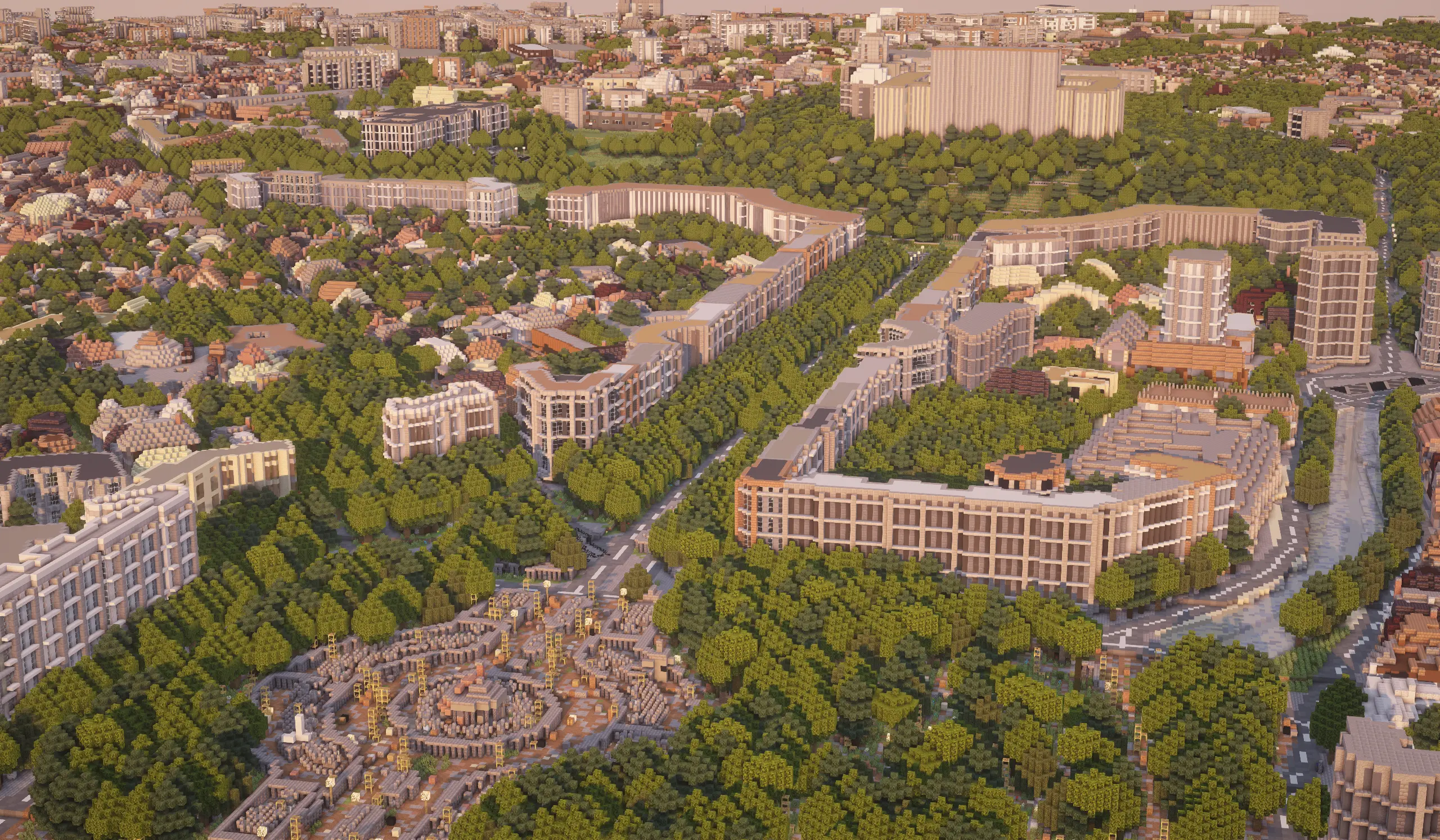

Meld exists because of this world. It began as a way to render all of Romania, and what it took to do that is now what anyone gets, for any place. The render on this page is the one that set the requirements.
What was generated
The selection is the whole country, drawn as one area on the map and rendered at 1:10, so a kilometre of real ground is a hundred blocks. No single Arnis instance holds a selection that size. Meld cut it into a grid of cells aligned to Minecraft region boundaries, all anchored to one project origin, and ran an Arnis per cell in parallel, as many as the machine could carry. The Carpathians, the Danube, Bucharest’s street grid, and the Black Sea coast all come from the same real map data: OpenStreetMap for roads, water, and land cover, plus real elevation.
Keeping the seams closed
Two mechanisms hold a build like this together. The first is the elevation lock: one elevation range and one tile-invariant seed across the whole world, so neighbouring cells agree on terrain height instead of each surveying its own patch and stepping at the border. The second is the region-perfect merge: each finished cell is stripped to its canonical region files and written into the master world behind a drift guard that refuses anything misaligned. Every seam lands on a region boundary, and you walk the result as one seamless world.
Built from baked data
A country-sized batch would run straight into the Overpass API’s rate limits, so this render came from local data instead. OSM was baked once from Geofabrik .pbf extracts into Meld’s shared tile cache, and elevation was pre-downloaded as a data pack. With both caches full, generation made zero Overpass calls, and any part of the country re-renders with no network at all. That workflow, bake once and build offline forever, was hardened on this world before it shipped as the offline data feature.
From world folder to server
A country in Anvil format is heavy on disk, so the export went through B_Linear: Meld’s bundled region converter builds a sibling world in Leaf’s B_LINEAR format, and Linear-family compression stores regions about 4.85 times smaller at level 9. That smaller copy is the one a server actually loads.
And one does load it. The world runs today on the RomaniaSMP Minecraft server, where the generated country is the map players walk.
What this proves
Everything in this case study is stock Meld: draw an area, bake the data, press Generate, export for a server. The same pipeline that handled a country handles a city block, and the failures found here (rate limits, cell seams, elevation drift, export size) are why the matching features exist.
Generated a place you care about? Post it in the Arnis Discord or open an issue on Teddy563/meld with a screenshot, the location, and the scale, and it can be featured here.